Crossword Puzzles for Seniors
A practical guide to printable crosswords for older solvers — comfortable print settings, forgiving grid sizes, themed sets for groups, and a routine that sticks.
Why crosswords earn their place in the day
A crossword gives an older solver three things at once: a small daily win, gentle practice at recalling words that sit somewhere just past the tip of the tongue, and a reason to keep a pencil sharp. It asks for patience instead of speed, welcomes a wrong answer that gets corrected two clues later, and finishes — unlike the news — on a note of completion.
None of that requires exaggeration. A puzzle is not medicine, and any site promising more than a pleasant quarter-hour is selling something. What a crossword reliably provides is structure: a task with a beginning, a middle, and a filled-in end, ready at the same time every morning.
Start one level easier than you think
Many solvers who pick up crosswords again in later life remember newspaper puzzles built to humble them. Those memories push people toward grids that are too hard on day one, and an abandoned puzzle is a habit that never forms. The fix is simple: begin with easy crossword puzzles — 9×9 grids with short answers and plain clues — and treat finishing as the whole point. A puzzle you complete beats a puzzle that impresses.
When an easy grid starts feeling quick rather than challenging, step up to the medium crossword puzzles. The clues stay in everyday language; only the grid and the answer lengths grow. Moving up because you got faster is a much better feeling than moving down because you got stuck.
Make the print comfortable first
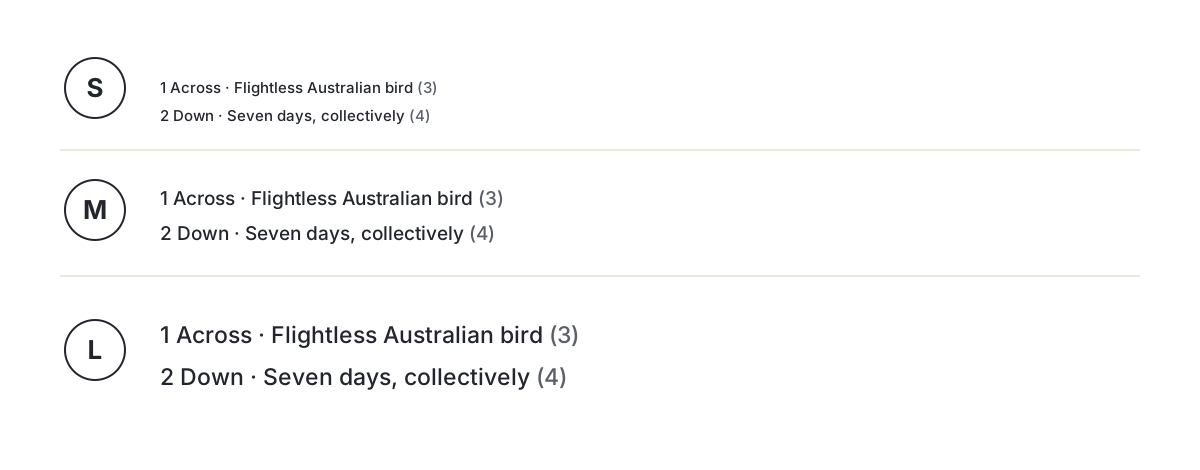
Before anything else, fix the printing. Every puzzle here prints with a clue-size setting — small, medium, large — and the large setting raises the clue text about twenty percent while adding space between the lines. That single choice matters more than any grid decision, because squinting at clues turns a pleasant puzzle into work. The large print printing guide walks through the settings in two minutes.
Pick the paper to match: letter in the United States and Canada, A4 elsewhere, and the grid scales to fill the sheet either way. The answer key always prints separately, which keeps the temptation honest — it can stay in a drawer until the grid is full or the day is over.
Pick a grid size that respects the afternoon
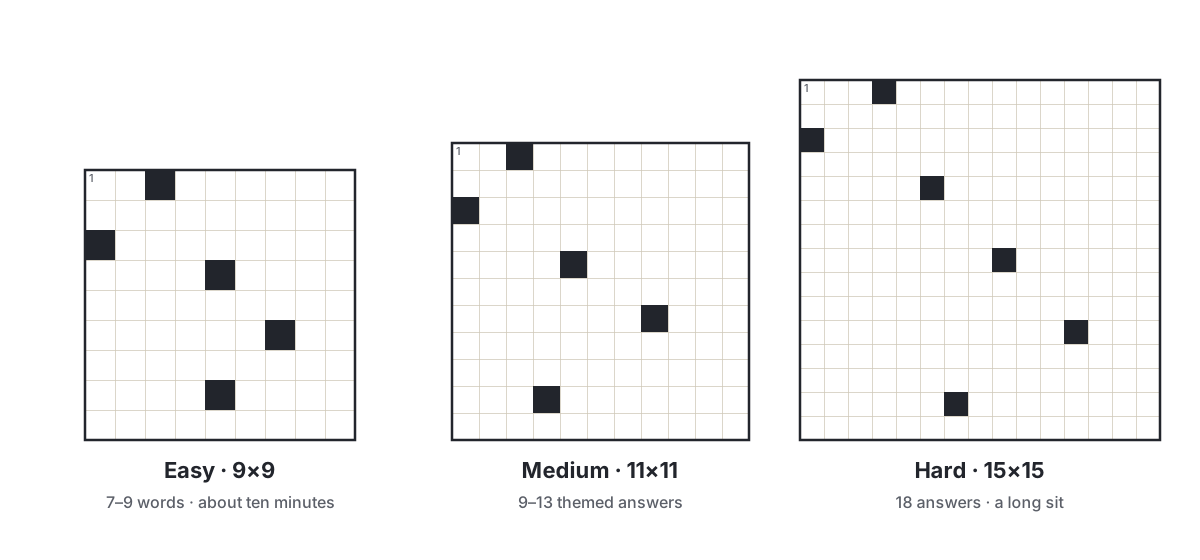
Bigger is not better; bigger is just longer. A 9×9 easy grid takes about ten minutes, an 11×11 medium grid makes a short sit of it, and a 15×15 hard grid is a project — one that happily splits across two afternoons if you fold the page and keep it by the chair. There is no medal for the big one.
One point in favor of smaller grids that rarely gets mentioned: the fewer the squares, the larger each square prints. A 9×9 grid fills the page with generous boxes that are kind to unsteady hands and easier pencil marks, while a 15×15 grid fits the same page with tighter cells. Solvers who find small boxes frustrating should start small — in grid size, that is — and enjoy the room. When the appetite grows, the hard crossword puzzles will still be there.
Themed grids make it a social hour
A crossword built for one is fine, but a themed grid is an excuse for company. Print a stack of the same themed puzzle — Christmas in December, music or movies any week — and a senior center activity hour runs itself: everyone gets the same sheet, the fast solvers coach the deliberate ones, and the room argues happily about a four-letter word for a jazz instrument.
History themes deserve a special mention. A World War II or geography grid often unlocks stories that would not otherwise come out that afternoon, because a clue is a question nobody had to ask directly. The puzzle does the prompting; the memories do the rest.
A weekly routine that sticks
Habits survive on sameness. Pick a time — with the morning coffee is the classic — print a week of puzzles on Sunday so the stack sits ready, and use a pencil, not a pen, because half the pleasure of a crossword is being allowed to change your mind.
Keep two rules and no more. First, no dictionary until a second pass at the grid has failed; a slow recall that eventually lands is the exercise working, not the exercise failing. Second, the answer key only comes out when the grid is full or the day is over, never mid-solve. Everything else — mug, chair, magnifier, the same pen-shaped pencil for twenty years — is personal style, and personal style is what makes a routine last.